Key Takeaways
Connecting multiple ShorePorts allows you to scale your setup as your fleet grows.
Front-mount vs. side-mount configurations impact access, spacing, and usability.
Proper alignment and spacing are critical for safe docking.
Choppy water requires more thoughtful placement and stabilization.
A well-configured system makes docking easier, faster, and safer.
Why Multi-PWC Docking Needs a Plan
Multi-PWC docking isn’t just about creating space—it’s about anticipating how multiple personal watercraft interact in a shared environment. Without a well-thought-out plan, riders can face bottlenecks when launching and docking, or, worse, risk damage when wakes from passing traffic push unsecured PWCs into each other.
When access, footprint, and operational efficiency are essential considerations, you need a versatile docking solution that’s specifically designed to protect and secure PWCs while seamlessly attaching to diverse dock setups.
This is where the ShorePort shines. Its modular design allows owners to create customized PWC docking layouts optimized for their available space today, while remaining flexible enough to expand as additional watercraft are added in the future.
How ShorePorts Connect: The Basics
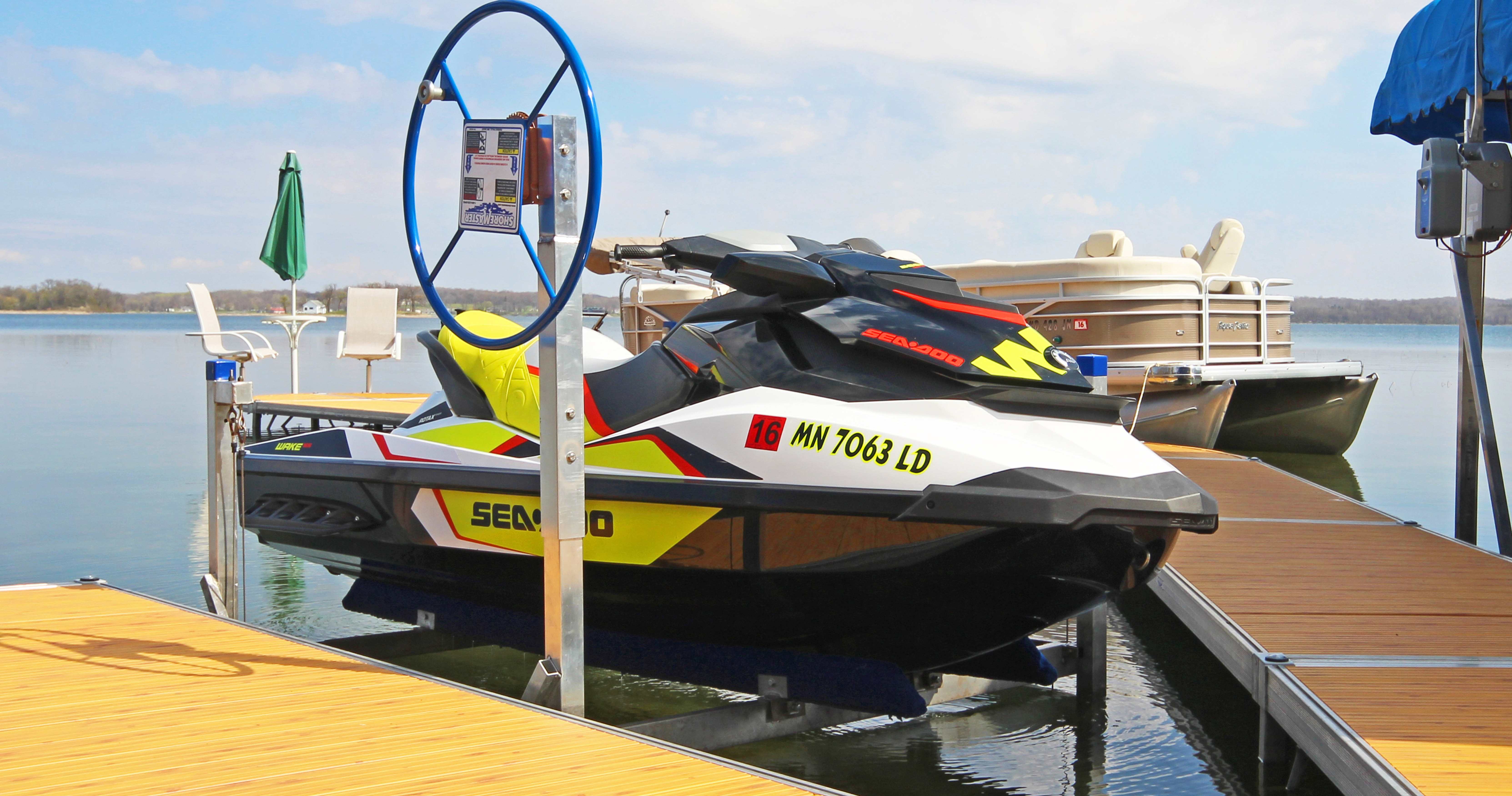
The ShorePort PWC lift is compatible with nearly any dock configuration, including floating, standing, and wheel-in systems, as well as seawalls. With a variety of anchoring and mounting options, including front connectors, side-mount hardware, and rear pipe brackets, this versatile jet ski port can be attached either alongside or perpendicular to most docks (Boat Lift Warehouse, 2021).
You can also use the ShorePort as a standalone dry docking solution for personal watercraft up to 1,150 lbs (up to 1,450 lbs with optional flotation inserts) or connect multiple ports to protect and secure an entire fleet of PWCs.
This versatility makes the ShorePort the ideal solution for marinas, resorts, rental businesses, or residential properties with multiple PWCs.
Front-Mount vs. Side-Mount Configurations
Determining the optimal PWC port layout depends largely on your existing dock setup and your prevailing traffic flow. The ShorePort attaches through two primary mounting configurations: front-mount and side-mount.
Pros of Front-Mounting:
Natural Drive-On Approach: Front-mounting the ShorePort allows riders to approach the PWC dock straight on from the open water. This makes throttling up onto the rollers highly intuitive, requiring no tight turning or awkward angles when approaching the platform.
Easier Modular Expansion: Front-mounting allows you to connect multiple ShorePorts side-by-side cleanly. You can seamlessly scale up from one port to a multi-PWC row by anchoring the outer edges with pipes.
Cons of Front-Mounting:
Waterfront Footprint: Extending a 13.8-foot-long ShorePort straight out into the water may block narrow channels, impede neighbors' property lines, or violate strict local shoreline extension regulations.
Vulnerability to Side-Wakes: Because the port is only secured at the front tip, rough water or heavy side-wakes may cause tail-whipping and pivoting. In rough conditions, owners must buy extra ShorePort rear pipe brackets and drive steel pipes into the lakebed at the back of the port to keep it stable.
Pros of Side-Mounting:
Waterfront Footprint: Side-mounting the ShorePort means it only extends out into the water by its width (approx. 58 inches) rather than its full length. This makes it ideal for narrow canals, tight property lines, or piers with space constraints.
Boarding, Fueling, and Servicing Access: Side-mounting the ShorePort allows users to step directly from the main dock platform right onto the side of the watercraft. This makes boarding, unloading gear, cleaning, fueling, and performing maintenance tasks relatively easier than on front-mounted ports.
Cons of Side-Mounting:
Parallel Approach: When side-mounted, riders cannot approach the ShorePort straight on from the open water. This may make docking more challenging, depending on the rider’s skill and prevailing traffic patterns.
Expansion Limits: Although ShorePorts are modular, side‑mounted units can make it harder to add multiple PWCs in a clean, linear fashion. Linking several side‑mounted ShorePorts may create a wide platform that feels awkward to navigate, especially in smaller waterfronts.
For best results, we recommend consulting an authorized ShorePort dealer to ensure the optimal anchorage and mounting solution for your unique shoreline conditions and dock system.
Spacing and Alignment: Setting Up for Easy Docking
Whenever possible, align each ShorePort with the most natural approach direction to make driving on as effortless as possible. Riders should be able to enter the port smoothly without making sharp turns at the last moment. This alignment not only improves convenience but also helps mitigate docking mistakes.
Take a few moments to observe the prevailing winds and typical boat traffic in your area. This allows you to determine the optimal spacing and alignment for riders of all skill levels.
When ShorePorts are linked together for a residential dock with 3-4 PWCs, the combined footprint distributes weight more evenly and resists shifting from wind, waves, or boat traffic. This stability makes docking smoother and safer, especially for riders who are still developing confidence.
Docking in Choppy Water: What Changes
Even for experienced riders, driving a PWC onto a floating platform can become significantly more challenging when wind, waves, and currents come into play (Nicholson, n.d.). When docking in less-than-ideal conditions, always approach the drive-on port with slow, steady momentum to maintain steering control against the wind and chop.
To minimize cross-wave impact, try to position ShorePorts so that the nose of the watercraft points into the prevailing waves rather than taking them from the side. This orientation helps stabilize the platform and prevents riders from being pushed off-center while driving on.
In rougher conditions, the strength of your mounting and anchorage is absolutely critical. ShoreMaster offers several options, including pipe brackets for fixed stability, flexi‑hinges for controlled movement, and stiff arms for added reinforcement.
Whatever system your setup requires, make it a habit to inspect anchors and connectors at least once a month to confirm they remain tight, corrosion‑free, and ready to withstand variable environmental forces.
Common Multi-Port Setup Mistakes
Even the best PWC ports won't perform well if the layout is flawed. Here are a few common pitfalls to avoid when planning your multiple jet ski docking system:
Leaving Insufficient Maneuvering Space: Riders should have enough room to maneuver comfortably, especially during busy weekends or high-traffic periods. Tight layouts often force sharp turns or awkward angles, which increase the risk of bumping into other PWCs or the dock itself.
Overlooking Approach Direction: Always plan your layout to favor the easiest, most natural path from the open water to the dock. Exercising foresight in this regard makes a significant difference in everyday convenience and long-term safety.
Overcomplicating the Layout: Often, the most intuitive PWC dock layouts are the simplest ones. Adding unnecessary angles, staggered spacing, or irregular connections can confuse riders and slow down operations. A clean, linear setup not only looks better but also makes launching and docking a much more seamless experience.
Taking the time to evaluate your waterfront before bolting everything together can make a significant difference in everyday convenience and long-term performance.
Building a Setup That Grows With You
Whether adding a second jet ski for visiting family or increasing docking capacity for customers, the ShorePort’s modular design makes it easy to evolve your setup as your requirements change.
Enter your zip code in the dealer locator tool at the bottom of the page to get a list of authorized ShoreMaster dealers near you, and learn more about building a PWC docking setup for your evolving needs.
FAQs
How do you connect multiple ShorePorts together?
ShoreMaster offers a variety of mounting options, including front connectors, side-mount hardware, and flexi-hinge brackets, allowing owners to attach multiple ports alongside or perpendicular to diverse dock setups.
What’s the best layout for docking multiple jet skis?
The best layout depends entirely on your waterfront space and the amount of dock footage you have available. For wide, open areas, a side-by-side configuration allows each PWC to be launched and docked independently without blocking access to others.
If you’re working with a narrow slip, a busy channel, or a long walking dock, an inline or side-mounted configuration is ideal for conserving valuable waterfront space.
Should I choose front-mount or side-mount ShorePorts?
Choose a front-mount configuration if you have plenty of open water and want an intuitive, straight-on approach that is easy for riders of all skill levels. If you’re dealing with a tight channel, heavy boat traffic, or want to minimize how far your setup extends into the water, a side-mount setup is better because it keeps the watercraft tucked parallel to the dock.
How much space do I need between PWC ports?
Premium PWC ports like the ShorePort are designed to be linked side-by-side. The dedicated mounting hardware and connector kits provide ample space for individual watercraft to launch and dock without handlebars or hulls clashing.
Can you safely dock jet skis in rough or choppy water?
Yes, PWCs can be safely docked in rough or choppy conditions when the docking system is properly positioned and securely connected. Aligning ports to reduce exposure to prevailing waves and wakes can make docking easier and improve stability. Riders should always approach at a controlled speed and maintain a straight entry path when conditions are less than ideal.
References:
Boat Lift Warehouse (January 14, 2021). Why Your Jet Ski Needs to be on a Shoremaster Shoreport, https://boatliftwarehouse.com/news/why-your-jet-ski-needs-to-be-on-a-shoremaster-shoreport/
Craig Nicholson, theintrepidcotagger.com (n.d.). Sea Doo Docking Tips PWC Docking Like A Pro, https://intrepidcottager.com/sea-doo-docking/